

Reading about the “revolutionary” nature of generative AI technology these days, it’s hard not to feel a little left out.
Sure, services like Google’s Gemini and its contemporaries can be useful in certain limited, specific areas for productivity purposes. But working with them can also be pretty disheartening and overwhelming — from prompt fatigue and an onslaught of AI workslop to the fear of lost jobs and even just the simple inconsistencies and inaccuracies these systems are so prone to providing. (And that’s to say nothing of the ever-increasing creepy factor that often accompanies this type of technology.)
More and more, it seems the most significant impact of these systems is in areas like coding, where AI is allowing ambitious tech-heads to create their own custom programs with limited to no programming knowledge (but a lot of time, vision, and patience) — as well as allowing accomplished coders to produce products more quickly by letting AI do the dirty work and then spending their time guiding, tweaking, and correcting its output.
That’s all well and good, but the reality is that most of us mere mortals are never gonna mess with anything that daunting. That doesn’t, however, mean we can’t enjoy a slice of the custom-coding pie and the productivity advantages it offers — on a much simpler but still supremely useful level.
The average-worker answer lies in an oft-overlooked middle-ground possibility these AI chatbots possess to help us create relatively basic but extremely high-potential custom browser extensions. As their name suggests, these simple little programs run entirely in your browser — the same exact sorts of add-ons you’d typically find and install in a marketplace like Google’s Chrome Web Store.
But with Gemini or any other similar genAI platform, you can dream up your own web-improving extension and turn it into reality in a matter of minutes — simply by describing your goal and then guiding the AI gently along the way. And given how much time most of us spend on the web these days, that opens up a tantalizing series of doors for taking total control of your work environment.
Hate all the extraneous bells and whistles gunking up the Google Docs interface? Gemini can create a Chrome extension that removes them. Annoyed by a glitchy web app? Ask Gemini for an extension that makes some under-the-hood improvements. The possibilities are endless.
Let me show you how exactly it works, how easy it is to approach and master, and how many work-enhancing possibilities are out there just waiting to be created.
The ins and outs of Gemini’s custom Chrome extensions
First things first: You don’t need any special tools or subscriptions to make this happen. For the purposes of this article, we’ll focus on Google’s Gemini for the creation and the standard desktop Chrome browser for the installation — but the same basic process would work with most any AI chatbot, if you happen to prefer ChatGPT or Claude, as well as with any extension-supporting, Chromium-compatible browser (a list that includes everything from Microsoft Edge to Brave, Vivaldi, and beyond).
Google offers a dizzying array of Gemini modes and options and an equally overwhelming series of AI subscription plans that control how much you can use those capabilities, but you don’t need to worry about any of that to create custom Chrome extensions. You might sometimes see better results if you switch your Gemini model to “Pro” or your Gemini thinking level to “Extended” — designations that even Gemini itself has trouble deciphering (believe me, I asked!) — but just using the default Gemini settings with a free Google account will generally work quite well.
Getting going with a custom Chrome extension is as simple as opening up a new Gemini chat and telling the system what you want it to cook up for you. The hardest part is deciding what you want and what’d be helpful for you — something we’ll explore more in a moment, via specific examples and suggestions. Once you’ve got that, you can just ask Gemini to create a Chrome extension that’ll accomplish what you’re envisioning, with as much specificity as possible about what it’ll do and how it’ll look.
Gemini will spit back a series of plain-text code chunks with instructions to copy each cluster and paste it into a new plain text file with a certain specific name — things like “manifest.json,” “content.js,” and “styles.css.” All you’ll do is use the on-screen button to copy each segment, then open up any simple text editor (like Windows Notepad, macOS TextEdit, or any number of simple online text editors) and paste the text in, then save it under the name Gemini gives you.
You’ll need to put all the files into a single isolated folder on your computer, and then you can go into Chrome, type chrome:extensions into its address bar, and install your shiny new creation by:
- Flipping the toggle next to “Developer mode” in the upper-right corner of the screen into the on and active position, if it isn’t already
- Clicking the “Load unpacked” button
- And selecting the folder you just created in the pop-up that appears

Chrome’s “Developer Mode” toggle and “Load unpacked” button are the keys to importing any extension you create.
JR Raphael / Foundry
And that’s pretty much it: No complicated compiling or program publishing — the extension you envisioned will be alive and working right in your browser and ready to use.
Now, odds are, it won’t be exactly what you wanted in its first iteration, and you’ll have to go back to Gemini to request several rounds of updates and corrections. Each time, Gemini will create a new set of code chunks, and you simply overwrite the text in each file with its corresponding new code chunk.
It’s still a bit of a process. But you’ll rarely spend more than an hour on something simple and maybe a few hours on something especially multifaceted and specific, and whatever you create will then work to your advantage indefinitely from that point onward, on any computer where you install it.
Before we dive into specific slivers of inspiration, let’s just note the hopefully obvious asterisk that this’ll work only if you’re either (a) using a personal computer that isn’t associated with an organization or (b) using a work-connected computer where custom Chrome extensions are permitted. In either scenario, you’ll want to use your own best judgment to ensure that whatever you’re adding into your browser won’t expose any corporate data or cause your IT comrades any alarm if they see you using it in your workday.
With most common examples, though — including all the ones we’re about to go over — you shouldn’t have any problem or cause for concern.
Capisce? Capisce. Let’s get into it.
Custom extension category #1: The interface fixer
Our first custom Chrome extension category is the one that won me over to this practice initially and has been the most shapeshifting for my own browser-based workflow — and that’s the simple-seeming but transformational ability to have AI remake any web app you rely on to remove unneeded elements and redesign the interface to your exact specifications.
The best example I can show you is what I did with my completely homemade, Gemini-created Docs Zen extension. Google Docs, to put it mildly, has devolved into a cluttered mess. There are so many on-screen elements I never use and, ironically enough, irrelevant AI elements I’d rather not have in my hair. I just want a calm, simple, minimalist environment for writing — with Google’s second-to-none syncing, universal access, and collaboration systems beneath it.
So rather than try to reinvent the wheel, I described to Gemini all the elements I wanted to remove from Docs and all the ways I wanted to rethink how its interface appeared for me.
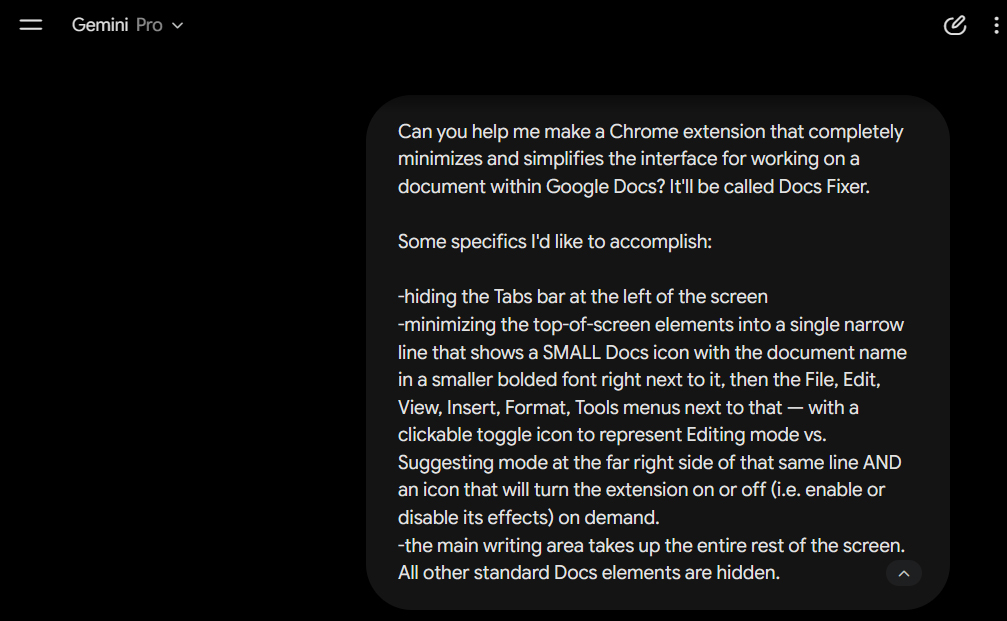
My original request to Gemini, followed by rounds of expansions and revisions (and eventually also a more poetic name).
JR Raphael / Foundry
I went back and forth with numerous iterations and kept coming up with interesting new additions to further flesh out and improve the experience — and I ended up with a delightful setup that gives me a distraction-free view of my writing space with a simple toggle to reveal the main Docs menus and a palette icon that allows me to switch from one eye-pleasing theme to another.
Google Docs with my custom Docs Zen extension — a true delight for daily writing.
JR Raphael / Foundry
My setup deliberately doesn’t include comments or other collaborative elements, as I’m mostly writing by myself these days — but when I do need those elements, the eye icon in the upper-right corner of the screen disables my custom adjustments and takes me back to the standard Docs interface. I can then click the eye icon again in that environment to switch back.

My custom extension includes a simple on-off toggle for times when I need the full Docs setup.
JR Raphael / Foundry
I used Gemini to create something similar for Trello, with which I also have a love-hate relationship — loving the foundational functions and easy access everywhere but hating the interface that’s lost focus, gained bloat, and gotten noticeably clunky and slow over time.
With the same sort of step-by-step, plain-English guidance, I was able to transform Trello from this…
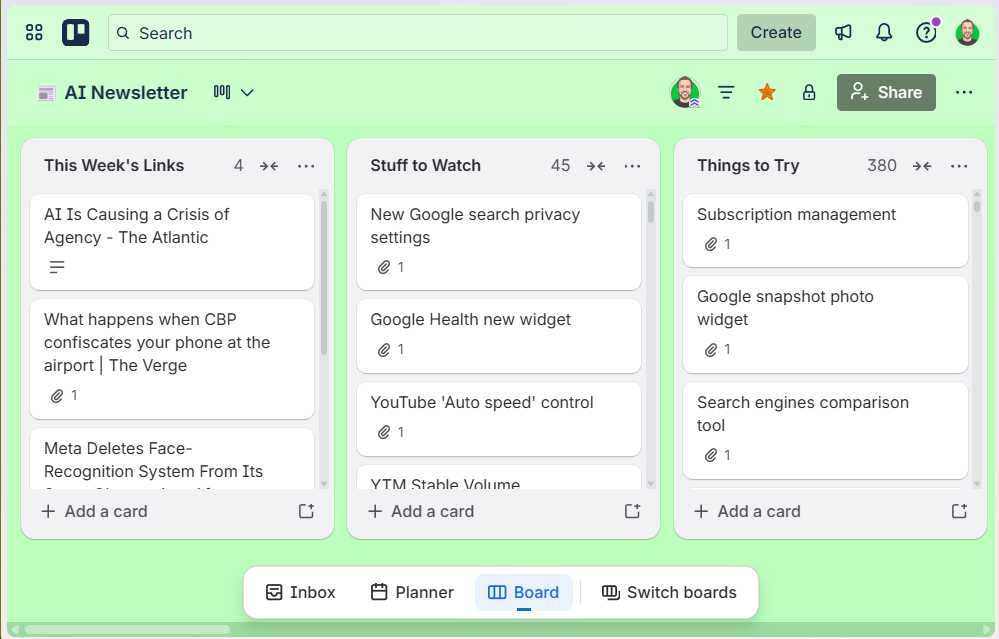
Trello, in its typical current-day state.
JR Raphael / Foundry
…into this:
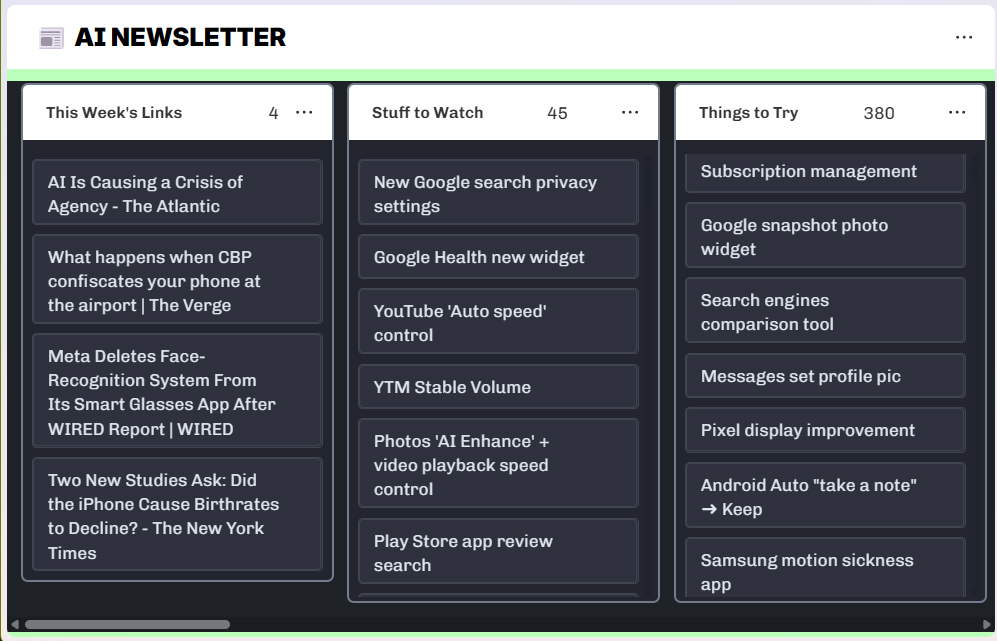
Trello, with my custom modifications in place.
JR Raphael / Foundry
I couldn’t even begin to recount the number of superfluous features and elements I’ve removed, along with revamping the overall interface to make it both more efficient and more visually pleasing to my eye.
Whether it’s a web app you rely on regularly or even just a website you open often, the possibilities are practically endless for the ways you can reshape it and mold it to make it work better for you.
Speaking of which…
Custom extension category #2: The feature creator
In addition to the surface-level adjustments and feature removals in my aforementioned Trello-enhancing extension, I also added in several components — such as one-click buttons for archiving or moving cards — and I managed to speed up the site by making some under-the-hood adjustments Gemini suggested when I asked about its choppy performance. The same sort of concept can apply to any web-based interface you’re using, if there are any options that are annoyingly buried within menus, shortcuts that’d make your life easier, or other improvements you’ve longed to see.
You can also consider some simple standalone extensions for giving yourself on-demand features that aren’t necessarily associated with any one specific website but could be useful in plenty of productivity scenarios. For instance:
- I do a fair amount of basic image editing and frequently find myself needing to reference a hex color code that corresponds with a particular brand color, and I always end up having to open up a new tab and look in a note somewhere to find the code I need. Well, no more: I used Gemini to create a super-simple custom color code pop-up where I can store all the colors I need and then copy any of ’em onto my clipboard with a single click. Major time-saver.
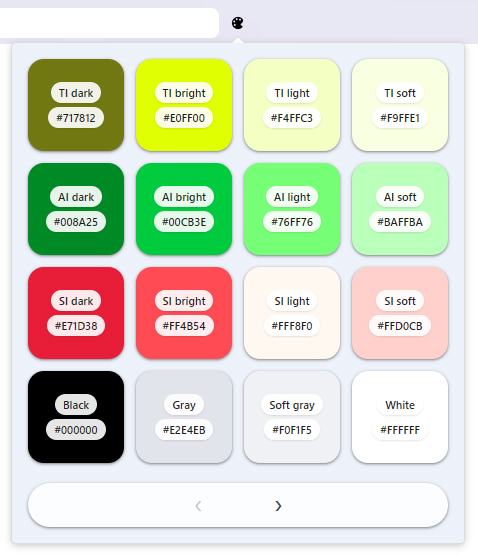
All the color codes I need are now never more than a couple clicks away.
JR Raphael / Foundry
- I’m also constantly converting time zones, either for meetings with clients or colleagues or for trying to wrap my head around publishing systems that insist on using random time zones with no meaning to me. It’s infinitely easier for me to manage now, thanks to the custom Chrome extension I made that shows the current time in all the zones I need most often — as well as allowing me to put any other time into any field and have all the other zones instantly adjust to match. It also offers a brilliant plain-text conversion box where I can just type things like “1pm-3pm PT in MT” and have it cough back up an instant answer for any conversion I need.
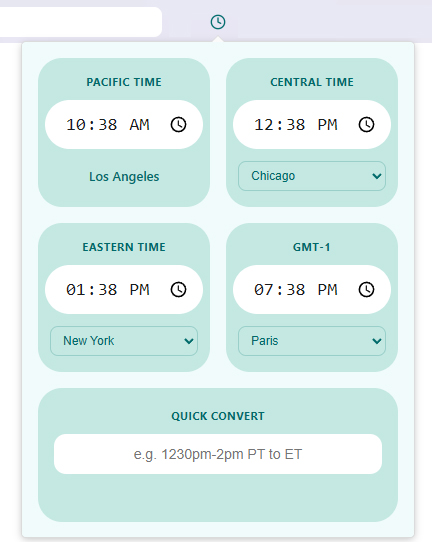
My custom time zone conversion extension comes in handy countless times a day.
JR Raphael / Foundry
Maybe what you want is the ability to interact with data on different websites more easily — to be able to save any table on a page in front of you as a CSV file, mayhap, or even to save any text you highlight on a page into a new Google Docs document. Whatever the case may be, Gemini can handle it — and that superpower that you’ve always wished for but never found the right tool to make possible can actually now be yours.
Custom extension category #3: The browser expander
Our final category of custom Chrome extensions to consider moves beyond the web itself and into your actual browser. The browser is essentially the modern-day desktop, after all — and for the first time now, you can expand and enhance it in all sorts of interesting ways.
Some specific examples, to get your brain-motor whirring:
- You could walk Gemini through creating a smart auto-snooze system for your open browser tabs, both to clear clutter and help with Chrome’s performance. It could save any tab that hasn’t been touched in a certain amount of time to your local storage and then give you a simple searchable “Archive Dashboard” where you can find all those auto-closed tabs and re-open ’em as needed.
- With the right guidance, Gemini could give you a custom browser research panel — where any info you highlight on a page gets beamed over into a sidebar-style panel that serves as a running scratchpad of notes from the day.
- Or, if you find yourself often needing to see two tabs together side by side, you could have Gemini cook up a custom extension that instantly detaches any tab in front of you and puts it into a new tab window in a perfectly sized and spaced pattern. One keyboard shortcut could make that move happen, while another keyboard shortcut could recombine the two tabs into a single centered window.
As with all the other ideas we’ve gone over, all you’ve gotta do is ask — and now, with the right inspiration in mind, you’re ready to get your custom extension adventures going and start bending the web to your will.