
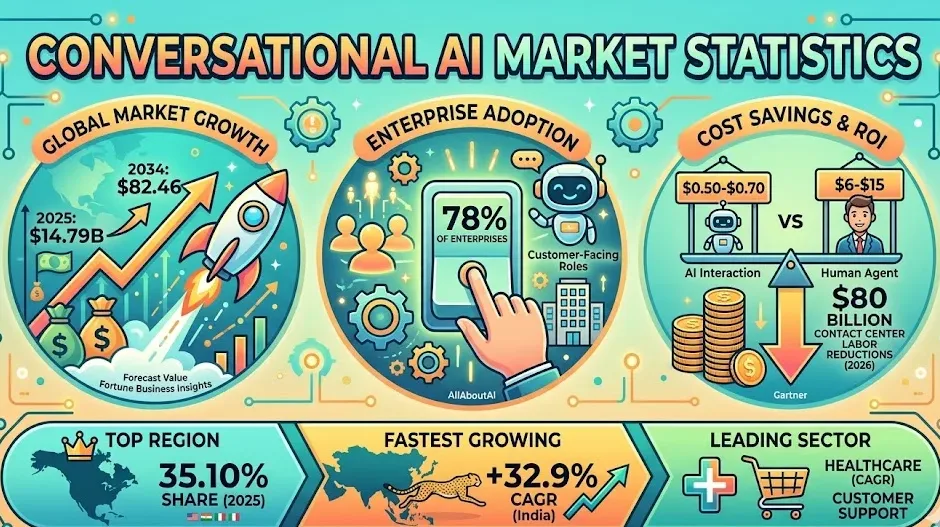
The global conversational AI market reached $14.79 billion in 2025 and is projected to hit $82.46 billion by 2034, based on Fortune Business Insights data. Enterprise adoption crossed a real threshold last year, with 78% of global companies running conversational AI in customer-facing roles. This brief covers market size, regional share, deployment data, consumer usage, and ROI figures from 2025 and 2026.
Conversational AI Market Statistics – TL;DR
- The conversational AI market sat at $14.79 billion in 2025 and is on track to $82.46 billion by 2034 (Fortune Business Insights).
- 78% of global enterprises ran conversational AI in at least one customer-facing function in 2025 (AllAboutAI).
- North America held 35.10% of the market in 2025; Asia Pacific posted the fastest growth rate (Fortune Business Insights).
- An AI chatbot interaction costs $0.50 to $0.70, against $6 to $15 for a human-handled one (chatbot.com).
- Gartner projects $80 billion in contact center labor cost reductions in 2026 from conversational AI.
The headline numbers point one direction: conversational AI moved past the pilot phase in 2025. Adoption now sits inside customer service, sales, and back-office functions across most large enterprises. Some of that growth shows up in Chromebook software too, with ChromeOS 134 replacing Google Assistant with Gemini and adding built-in AI tools directly into the operating system.
How Big Is The Conversational AI Market In 2026?
The global conversational AI market was valued at $14.79 billion in 2025 and is projected to grow to $17.97 billion in 2026, according to Fortune Business Insights. The same firm forecasts the market reaching $82.46 billion by 2034 at a 21.00% CAGR.
Estimates differ across research firms because each defines the category slightly differently. Precedence Research puts the 2025 figure at $19.21 billion, climbing to $155.23 billion by 2035 at a 23.24% CAGR.
IMARC Group projects the widest growth at 28.00% CAGR through 2034. MarketsandMarkets places the 2025 value at $17.05 billion, with a forecast of $49.80 billion by 2031.
| Research Firm | 2025 Value | Forecast Value | CAGR | End Year |
|---|---|---|---|---|
| Fortune Business Insights | $14.79B | $82.46B | 21.00% | 2034 |
| Precedence Research | $19.21B | $155.23B | 23.24% | 2035 |
| IMARC Group | $17.6B | $172.5B | 28.00% | 2034 |
| MarketsandMarkets | $17.05B | $49.80B | 19.60% | 2031 |
| Business Research Company | $13.64B | $42.51B | 25.50% | 2030 |
Source: Fortune Business Insights, Precedence Research, IMARC Group, MarketsandMarkets, The Business Research Company
Market Size: 2025 vs Forecast Value
Conversational AI Market Statistics By Region
North America held 35.10% of the global conversational AI market in 2025, per Fortune Business Insights. The U.S. portion is projected to reach $4.28 billion in 2026.
Asia Pacific accounted for $3.16 billion in 2025, or 21.40% of the market, and is the fastest-growing region. The region is expected to reach $3.93 billion in 2026.
At the country level, India leads forecast growth between 2026 and 2034 at a 32.9% CAGR. China follows at 27.5%, and the United Kingdom at 22.8%, based on Master of Code data.
| Region | 2025 Share | 2025 Value | Growth Profile |
|---|---|---|---|
| North America | 35.10% | Largest market | Mature adoption |
| Europe | 27-29% (est.) | Second largest | Moderate growth |
| Asia Pacific | 21.40% | $3.16B | Highest CAGR |
Source: Fortune Business Insights
Conversational AI Regional Share 2025
Enterprise Conversational AI Deployment Statistics
78% of global enterprises reported using conversational AI in at least one customer-facing function in 2025, per AllAboutAI. Among service organizations specifically, 73% run a chatbot.
Contact centers show even broader adoption, with 88% using AI in some form, per Salesforce. The same report found that 30% of service cases are now resolved by AI, with the firm projecting 50% by 2027.
The pressure to deploy is coming from the top. 91% of customer service and support leaders say executive leadership is pushing them to implement AI, per SlickText.
Gartner expects 40% of enterprise applications to feature task-specific AI agents by 2026, up from less than 5% in 2025. Browser-based chat-based AI platforms are part of that shift inside lighter-weight enterprise environments.
| Metric | Figure | Year |
|---|---|---|
| Enterprises using AI in customer-facing function | 78% | 2025 |
| Service organizations running a chatbot | 73% | 2025 |
| Contact centers using AI | 88% | 2025 |
| Service cases resolved by AI | 30% | 2025 |
| Support leaders pressured to deploy AI | 91% | 2025 |
Source: AllAboutAI, Zendesk, Salesforce, SlickText
Chatbot Usage Statistics Among Consumers
82% of consumers say they would rather use a chatbot than wait for a human agent for quick, simple transactions, per chatbot.com. 51% prefer interacting with bots over humans when immediate service is the goal.
The catch: only 2% want to deal with generative AI chatbots exclusively, and 87% prefer a hybrid model that pairs AI efficiency with human empathy, per Pega/YouGov and Zendesk.
Trust is fragile. Consumer trust in AI slipped from 62% in 2023 to 59% in 2025, per Avaya. The share calling AI “very untrustworthy” more than doubled, from 5% to 12%.
On the voice side, 157.1 million people in the U.S. are projected to use voice assistants by 2026. 50% of consumers have already completed a purchase through one, per Shopify. Adjusting voice assistant settings on Chrome sits alongside that growing daily usage on laptops.
| Consumer Behavior | Percentage | Year |
|---|---|---|
| Would use a chatbot rather than wait for a human | 82% | 2026 |
| Prefer bots over humans for immediate service | 51% | 2026 |
| Prefer a hybrid human-plus-AI support model | 87% | 2025 |
| Want to interact exclusively with GenAI chatbots | 2% | 2025 |
| Made a purchase using a voice assistant | 50% | 2025 |
Source: chatbot.com, Zendesk, Pega/YouGov, Shopify
Consumer Chatbot Preferences
Conversational AI Cost Savings And ROI Statistics
Gartner estimates conversational AI will cut $80 billion in contact center labor costs in 2026. The per-interaction math drives that figure.
An AI chatbot interaction runs $0.50 to $0.70, against $6 to $15 for a human-handled one, per chatbot.com. The gap explains why service leaders are scaling deployments so quickly.
Klarna’s AI assistant handled two-thirds of its customer service chats, cut average resolution time from 11 minutes to under 2 minutes, and produced a $40 million profit improvement in 2024.
Intercom’s Fin AI resolves 81% of support volume, work that would have required around 100 additional staff. The savings run $7.5 million to $9 million a year.
Quality remains uneven. The average AI chatbot resolution rate across industries sits at 44.8%, per Comm100. That gap between named enterprise results and the broader average shows execution still varies widely.
| Metric | Figure | Source |
|---|---|---|
| Projected contact center labor cost reduction (2026) | $80 billion | Gartner |
| Cost per AI chatbot interaction | $0.50-$0.70 | chatbot.com |
| Cost per human agent interaction | $6-$15 | chatbot.com |
| Klarna AI assistant profit improvement (2024) | $40 million | Klarna |
| Intercom Fin AI annual saving | $7.5M-$9M | Intercom |
Source: Gartner, chatbot.com, Klarna, Intercom
Cost Per Customer Interaction
Conversational AI Market Statistics By Segment
AI chatbots held the largest type-based share of the conversational AI market in 2025, per Fortune Business Insights. By deployment, cloud-based systems generated 78.4% of chatbot revenue in 2024.
Customer support accounted for 42.4% of the chatbot market in 2024, making it the single biggest application. Healthcare and life sciences leads industry growth at 20.1% CAGR through 2030, helped by projected U.S. healthcare savings of around $150 billion annually by 2026 from AI applications.
Generative AI usage tells the same story plainly. ChatGPT surpassed 800 million weekly active users in late 2025, up from 300 million a year earlier, per Tidio. Broader AI mode usage statistics track the same upward curve across major platforms.
Google’s Gemini sits inside ChromeOS as a system-level chatbot, replacing Google Assistant on Chromebook Plus devices. The integration of Gemini AI into browsing is one example of how conversational AI is moving from app to operating system.
| Segment | Leading Category | Share | Year |
|---|---|---|---|
| Type | AI chatbots | Largest share | 2025 |
| Deployment | Cloud-based | 78.4% of revenue | 2024 |
| Application | Customer support | 42.4% of chatbot market | 2024 |
| Industry growth | Healthcare | 20.1% CAGR | 2025-2030 |
Source: Fortune Business Insights, MarketsandMarkets, Tidio
FAQs
How big is the conversational AI market in 2026?
The global conversational AI market is projected to reach $17.97 billion in 2026, up from $14.79 billion in 2025, per Fortune Business Insights. The market is forecast to hit $82.46 billion by 2034 at a 21.00% CAGR.
What percentage of enterprises use conversational AI?
78% of global enterprises used conversational AI in at least one customer-facing function in 2025, per AllAboutAI. Among service organizations, 73% run a chatbot, and 88% of contact centers use AI in some form.
How much do companies save with conversational AI?
Gartner estimates conversational AI will cut $80 billion in contact center labor costs in 2026. AI chatbot interactions cost $0.50 to $0.70 versus $6 to $15 for human agents. Klarna posted a $40 million profit improvement from its AI assistant.
Which region leads the conversational AI market?
North America held 35.10% of the global market in 2025, with the U.S. portion projected at $4.28 billion in 2026. Asia Pacific accounts for $3.16 billion and is the fastest-growing region, with India leading country-level growth at 32.9% CAGR.
What share of customer service cases does AI handle?
AI resolves 30% of service cases in 2025, with Salesforce projecting 50% by 2027. Intercom’s Fin AI handles 81% of support volume at its deployments. The average AI chatbot resolution rate across industries is 44.8%.
Sources
https://www.fortunebusinessinsights.com/conversational-ai-market-109850
https://www.marketsandmarkets.com/Market-Reports/conversational-ai-market-49043506.html
https://www.thebusinessresearchcompany.com/report/conversational-ai-global-market-report
https://www.futuremarketinsights.com/reports/conversational-ai-market