
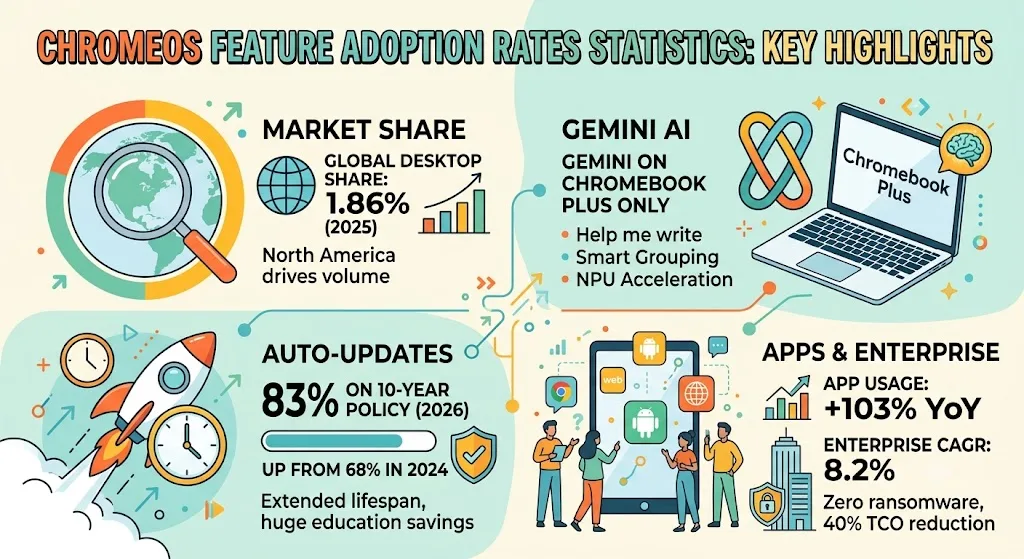
ChromeOS holds 1.86% of the global desktop market in 2025, yet 83% of its active fleet now sits on the 10-year auto-update policy in 2026, up from 68% just two years earlier. This post covers how ChromeOS feature adoption rates are split across Gemini, Chromebook Plus hardware, Android apps, Linux containers, and enterprise deployments using data from 2024 to mid-2026.
ChromeOS Feature Adoption Rates – TL;DR
- ChromeOS sits at 1.86% global desktop share and 8.44% US desktop share in 2025, based on StatCounter data.
- 83% of active Chromebooks qualify for the 10-year auto-update policy in 2026, up from 68% in 2024.
- App usage on ChromeOS for Android, Web, and Games grew 103% year over year, per ChromeOS.dev.
- Gemini in Chrome reached Chromebook Plus users in February 2026, around five months after Windows and macOS.
- Lenovo’s Chromebook Plus 14 became the first ChromeOS device with a 50 TOPS NPU in June 2025.
ChromeOS feature adoption rates in 2026 split cleanly between two groups: the base ChromeOS fleet on the 10-year update path that gets core features, and the Chromebook Plus tier with 8 GB RAM and 128 GB storage that unlocks Gemini, on-device AI, and NPU acceleration. Schools drive volume on the lower tier, while enterprise drives revenue growth at 8.2% CAGR.
How Big Is ChromeOS Market Share In 2026?
ChromeOS holds 1.86% of global desktop share and 8.44% of US desktop share in 2025, per StatCounter. The US figure runs 4.5 points higher because of education buying. North America accounts for 38.57% of global Chromebook unit volume.
| Metric | Value |
|---|---|
| ChromeOS global desktop share (Mar 2025) | 1.86% |
| ChromeOS US desktop share (2025) | 8.44% |
| Chromebooks shipped in 2025 | 22.11 million units |
| Chromebook market value (2025) | $14.7 billion |
| Global Chromebook units shipped (2025) | 13.10 million |
| North America share of global volume | 38.57% |
Source: StatCounter, About Chromebooks, Custom Market Insights
For monthly StatCounter movement and a four-quarter view of how the share has shifted, the Chrome OS desktop market share data has the granular breakdown.
Gemini AI Feature Adoption Across ChromeOS
Gemini features cluster on the Chromebook Plus tier rather than the full ChromeOS install base. The 8 GB RAM and 128 GB storage minimum gates most of them, so uptake tracks Chromebook Plus shipments. Gemini in Chrome landed on ChromeOS roughly five months after Windows and macOS.
| Gemini Feature | Launch Date | ChromeOS Availability |
|---|---|---|
| Gemini in Chrome (Windows/Mac) | September 2025 | February 2026, Plus only |
| Help me write (native) | March 2024 | All Chromebook Plus |
| Smart Grouping (on-device NPU) | June 2025 | Lenovo Chromebook Plus 14 |
| Magic Editor in Gallery | March 2024 | Chromebook Plus |
| NotebookLM in shelf | 2025 | All Chromebook Plus |
| Quick Insert key | 2024 | Chromebook Plus only |
Source: Google Blog, 9to5Google, Lenovo
Google bundles 12 months of Google AI Pro, a $239.88 value, with every Chromebook Plus purchase, which converts hardware buyers into Gemini Advanced users by default. The breakdown of who actually uses these tools sits in the Chromebook Plus adoption data.
Chromebook Plus Feature Adoption And Hardware Tier Statistics
The Chromebook Plus tier shifted from a software label in 2024 to a hardware class with a dedicated NPU in mid-2025. Lenovo’s Kompanio Ultra 910 unit posted Geekbench 6 scores 2.2 times higher single-core and 1.7 times higher multi-core than Acer’s Intel Core 3 Chromebook Plus 514. Pricing has stayed flat year over year.
| Hardware Indicator | Value |
|---|---|
| Chromebook Plus minimum RAM | 8 GB |
| Chromebook Plus minimum storage | 128 GB |
| Touchscreen share of Chromebook shipments | 52% |
| Clamshell share of education shipments | 62.85% |
| First ChromeOS NPU rating | 50 TOPS (MediaTek NPU 890) |
| Chromebook Plus price range | $349 to $699 |
| Standard Chromebook price range | $200 to $400 |
Source: Google, Lenovo, About Chromebooks
The school market sticks to the lower tier where AI features are absent. That gap is the central reason Gemini adoption tracks Plus shipments rather than the whole ChromeOS fleet.
ChromeOS Auto-Update Feature Adoption Rates
83% of active Chromebooks qualify for the 10-year auto-update policy in 2026, up from 68% in 2024, per About Chromebooks. The 22.1% rise reflects pre-2021 hardware aging out, not a policy change. Google’s 10-year window has been static since September 2023.
| Update Policy Metric | Status |
|---|---|
| Devices on 10-year auto-update policy (2026) | 83% |
| Same figure, 2024 | 68% |
| Update installation rate, all active devices | 85%+ |
| Update installation rate, new devices | 90% to 95% |
| Stable channel cadence | 4 to 6 weeks |
| Major versions per year | 10 to 13 |
| Average education Chromebook lifespan (2026) | 8.1 years |
| Pre-2024 education Chromebook lifespan | ~4 years |
| Estimated US school savings from 10-year policy | $1.8 billion |
Source: About Chromebooks, PIRG Education Fund, Google Chrome Enterprise
Google plans a two-week stable cycle starting with Chrome 153 in September 2026, roughly doubling release speed. Coverage trends and lifespan averages by segment sit in the Auto Update Expiration breakdown.
How Many People Use Android Apps And Linux On Chromebooks?
App usage on ChromeOS for Android, Web, and Games grew 103% year over year, with user engagement up 124% over the same period, per ChromeOS.dev. Chrome Apps were retired in July 2025, leaving Android packages and PWAs to handle installation duties.
| App and Container Metric | Value |
|---|---|
| App usage YoY growth (Android, Web, Games) | +103% |
| User engagement YoY growth | +124% |
| Free apps share of Play Store catalog | 96.98% |
| Crostini default Linux distribution | Debian |
| Debian developer personal-use share (2025) | 9.8% |
| Chrome 140 RAM use, 10 active tabs | ~1.4 GB |
| Minimum ChromeOS version for Crostini | ChromeOS 69 |
| Steam beta for ChromeOS end date | January 1, 2026 |
Source: ChromeOS.dev, Statista, Stack Overflow Developer Survey 2025
Stack Overflow’s 2025 survey of 49,000+ developers showed Android personal-use share jumping from 17.9% to 29% year over year, overtaking Ubuntu. The Crostini Linux container needs at least 10 GB free, which puts 4 GB / 32 GB education Chromebooks out of practical reach. Installation share and use cases for the Android layer sit in the Android app usage on Chromebooks data.
ChromeOS Feature Adoption Rates In Enterprise
The enterprise segment grows at 8.2% CAGR while education still drives volume at 60.1% of total Chromebook sales. ChromeOS recorded zero OS-level CVEs in 2024 and remains the only major desktop OS without a documented ransomware case as of mid-2026.
| Enterprise Metric | Value |
|---|---|
| Enterprise Chromebook CAGR | 8.2% |
| Large enterprise cloud infrastructure adoption | 74% |
| SMB cloud infrastructure adoption | 44% |
| TCO reduction vs Windows/macOS (350-employee org) | Up to 40% |
| Three-year cost savings, 350-employee org | ~$1.3 million |
| Hardware service call reduction | 90% |
| Documented ChromeOS ransomware attacks through 2026 | 0 |
| Windows machines crashed in July 2024 CrowdStrike incident | 8.5 million |
| ChromeOS devices affected by CrowdStrike | 0 |
Source: Forrester TEI, About Chromebooks, Microsoft
The July 2024 CrowdStrike outage that crashed 8.5 million Windows machines and caused an estimated $5.4 billion in Fortune 500 losses affected zero ChromeOS devices, a data point IT directors now cite during procurement. The full deployment patterns by company size and vertical sit in the enterprise Chromebook adoption report.
Final Read On ChromeOS Feature Adoption Rates In 2026
ChromeOS feature adoption rates split along two lines: the 83% of devices on the 10-year update policy that get every base feature on time, and the Chromebook Plus tier with 8 GB RAM and 128 GB storage that gates Gemini, NPU acceleration, and Help me write. Schools still drive volume at 60.1% of sales, while enterprise drives revenue growth at 8.2% CAGR.
The metric worth watching through the rest of 2026 is Chromebook Plus shipment share, since it sets the ceiling on how many users can actually run the features Google is shipping at the top end of the platform.
FAQs
What percentage of Chromebooks get 10-year updates in 2026?
83% of active Chromebooks qualify for the 10-year auto-update policy in 2026, up from 68% in 2024. The rise reflects pre-2021 hardware aging out of service rather than a policy change, per About Chromebooks data.
Which Chromebooks get Gemini AI features?
Gemini features are limited to Chromebook Plus devices with 8 GB RAM and 128 GB storage minimum. Gemini in Chrome reached Plus users in February 2026, about five months after Windows and macOS launches in September 2025.
How much desktop market share does ChromeOS hold?
ChromeOS holds 1.86% of global desktop share and 8.44% of US desktop share in 2025, per StatCounter. The US figure runs higher because of education buying, with North America accounting for 38.57% of global Chromebook unit volume.
How much can enterprises save by switching to ChromeOS?
A 350-employee organization can cut total cost of ownership by up to 40% versus Windows or macOS, saving around $1.3 million over three years, according to a Forrester Total Economic Impact study. Hardware service calls drop by 90%.
How much did Android app usage grow on ChromeOS?
App usage for Android, Web, and Games grew 103% year over year on ChromeOS, with user engagement up 124% over the same period, per ChromeOS.dev. Free apps make up 96.98% of the Play Store catalog available to Chromebook users.
Sources
https://gs.statcounter.com/os-market-share/desktop/worldwide