
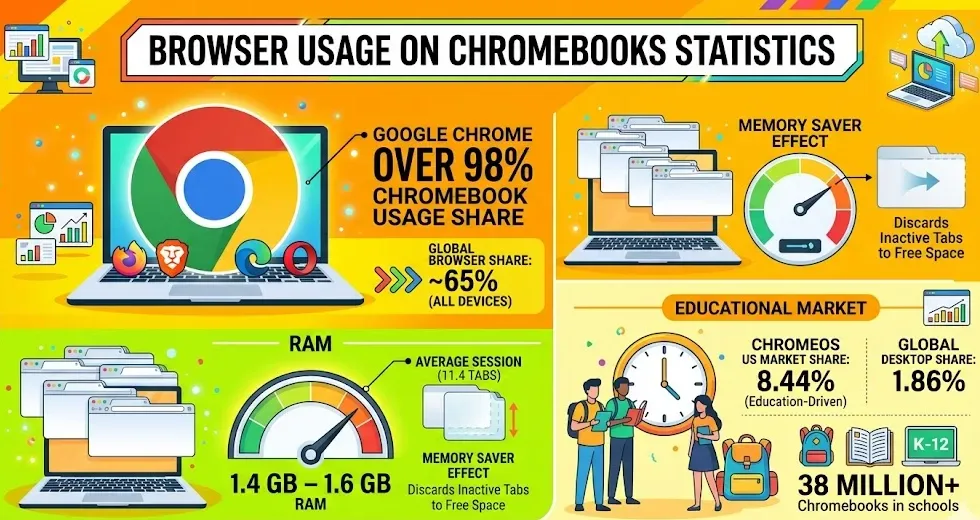
Google Chrome generates more than 98% of all web traffic on Chromebooks, a share no browser holds on any other operating system. ChromeOS is built around Chrome as its interface, so alternatives barely register. This post covers Chrome’s share on Chromebooks, the global browser market for context, RAM use per tab, and ChromeOS market share by region for 2026.
Browser Usage on Chromebooks — TL;DR
- Chrome accounts for over 98% of Chromebook browser traffic, versus its 65% global share.
- Chrome had about 3.45 billion active users worldwide in 2026.
- A typical session of 11.4 open tabs draws 1.4 GB to 1.6 GB of RAM on ChromeOS.
- ChromeOS holds 1.86% of the global desktop OS market and 8.44% in the United States.
- More than 38 million Chromebooks run in K-12 schools, where Chrome is the only browser most students touch.
Browser usage on Chromebooks is close to a monopoly. ChromeOS ships with Chrome pre-installed as the operating system shell, and no setting swaps it out. Firefox, Brave, and Edge reach ChromeOS only through the Linux container or Android app layer, both disabled on most managed school and enterprise devices. The result: under 1% of Chromebook users run anything but Chrome.
What Browser Do Chromebooks Use?
Chrome runs more than 98% of Chromebook web traffic, per DigitalApplied data citing StatCounter. The figure is structural, not a preference. Chrome is the graphical shell of ChromeOS, so changing the browser means replacing the OS interface. The sub-1% running Brave or Firefox are advanced users who enabled the Linux container. You can see how that layer works in the Linux container usage on Chromebooks breakdown.
| Browser | Chromebook Usage Share | How It Runs on ChromeOS |
|---|---|---|
| Google Chrome | >98% | Pre-installed; the OS shell |
| Brave | <1% | Linux container or Android app |
| Firefox | <1% | Linux container or Android app |
| Microsoft Edge | Near zero | Android app only |
| Opera | Near zero | Android app only |
| Safari | Zero | Not available |
Source: DigitalApplied “Browser Market Share 2026”; About Chromebooks ChromeOS usage data
The gap between Chrome’s 65% global share and its 98%+ Chromebook share is fixed by design. Windows users install and switch browsers; Chromebook users cannot. Google disables the Linux container by default on managed education and enterprise fleets, and those fleets cover the bulk of deployed devices. Most Chromebook owners never open a second browser. Wider context sits in the Chromebook market data.
Browser Usage on Chromebooks vs the Global Browser Market
Chrome held about 65% of the worldwide browser market across all devices in March 2026, according to About Chromebooks data drawn from StatCounter. Its roughly 3.45 billion users make it the most-used software application of any kind. Safari ranks second near 18%, lifted by iOS. Edge sits around 5% all-device, and Firefox near 2.8% on Mozilla’s Gecko engine. Full figures are in the Google Chrome usage statistics.
| Browser | Global Share (All Devices, 2026) | Engine / Note |
|---|---|---|
| Google Chrome | ~65% | Blink; ~3.45B users |
| Apple Safari | ~18% | WebKit; iOS-driven |
| Microsoft Edge | ~5% | Chromium-based |
| Mozilla Firefox | ~2.8% | Gecko |
| Opera | ~2% | Chromium-based |
| Samsung Internet | ~2% | Chromium-based |
Source: StatCounter Global Stats (March 2026); About Chromebooks Google Chrome Statistics
Chromium powers Chrome, Edge, Brave, Opera, and Samsung Internet. About 83% of all browser traffic now runs on Google’s Blink engine. Firefox is the main holdout on a non-Chromium engine. That concentration shapes how the open web is built, a thread picked up in the ChromeOS app ecosystem data.
How Much RAM Does Chrome Use on a Chromebook?
The average Chrome session holds 11.4 open tabs, per Nielsen data reported through About Chromebooks. At that size, Chrome 140 draws 1.4 GB to 1.6 GB of RAM. On a 4 GB Chromebook that is a third or more of total memory before any apps load. ChromeOS Memory Saver then discards inactive tabs to free space, with detail in the average RAM usage on ChromeOS report.
| Tab Load | Chrome RAM Use | Note |
|---|---|---|
| 6 tabs | ~1.4 GB | Comfortable on 4 GB devices |
| 11.4 tabs (average session) | 1.4–1.6 GB | Triggers Memory Saver on 4 GB models |
| 20 tabs | ~1.9 GB | Heavy load for entry-level RAM |
| Inactive background tab | 200–500 MB each | Discarded by Memory Saver |
| Memory Saver effect | Up to 80% less per tab | Suspends inactive tabs |
| Chromebook Plus minimum RAM | 8 GB | Halves the memory pressure |
Source: About Chromebooks Average RAM Usage on ChromeOS Statistics
Memory Saver cuts inactive tab RAM by up to 80%, and Google’s data shows 60% of discarded tabs get revisited within a day. Chromebook Plus models require 8 GB, so 11 tabs use only about a fifth of memory. The discard mechanics are covered in the Chrome tab recovery data.
Browser Usage on Chromebooks by Region
ChromeOS held 1.86% of the global desktop OS market in March 2026 and 8.44% in the United States, per StatCounter via About Chromebooks. That 4.5× gap traces to K-12 schools. When StatCounter logs a US ChromeOS session, it is almost always a Chrome session on a school-issued device. School demand sits in the education Chromebook adoption figures.
| Metric | Figure |
|---|---|
| ChromeOS global desktop OS share | 1.86% |
| ChromeOS US desktop OS share | 8.44% |
| US-to-global ratio | 4.5× |
| Chromebooks active in K-12 worldwide | 38 million+ |
| US districts planning purchases (2026) | 93% |
| Google Workspace for Education users | 170 million |
Source: StatCounter via CommandLinux; About Chromebooks education data
Education accounts for 60.1% of global Chromebook sales, and 93% of US districts planned new purchases in 2026. ChromeOS is the only desktop OS where browser identity can be read from OS identity with confidence above 98%. Panel-based measurement tends to undercount school networks, so the 8.44% US figure reads as a floor. How those devices stack up against iPads is in the Chromebook versus tablet classroom data.
FAQs
What browser do most Chromebook users use?
Google Chrome runs over 98% of Chromebook web traffic. ChromeOS ships with Chrome as its interface and no alternative pre-installed, so nearly every user stays on Chrome. Other browsers need the Linux container or Android layer, both disabled on managed devices.
Can you use Firefox or Edge on a Chromebook?
Yes, but only through optional layers. Firefox installs via the Linux container, and Firefox and Edge run as Android apps. Both routes are disabled on most school and work Chromebooks, so under 1% of users run any browser besides Chrome.
How much RAM does Chrome use on a Chromebook?
An average session of 11.4 tabs uses 1.4 GB to 1.6 GB of RAM. On 4 GB Chromebooks this triggers Memory Saver, which discards inactive tabs. Chromebook Plus models require 8 GB and hit that limit far less often.
What is Chrome’s global browser market share in 2026?
Chrome held about 65% of the worldwide browser market across all devices in 2026, with roughly 3.45 billion users. Safari ranked second near 18%, followed by Edge at about 5%. Chrome’s Chromebook share of 98%+ runs well above that average.
What is ChromeOS’s market share in 2026?
ChromeOS held 1.86% of the global desktop OS market in March 2026 and 8.44% in the United States, a 4.5× gap driven by K-12 schools. More than 38 million Chromebooks run in classrooms worldwide.
Sources:
https://www.digitalapplied.com/blog/browser-market-share-2026-complete-statistics
https://gs.statcounter.com/os-market-share/desktop
https://commandlinux.com/statistics/chromeos-market-share-in-education/