
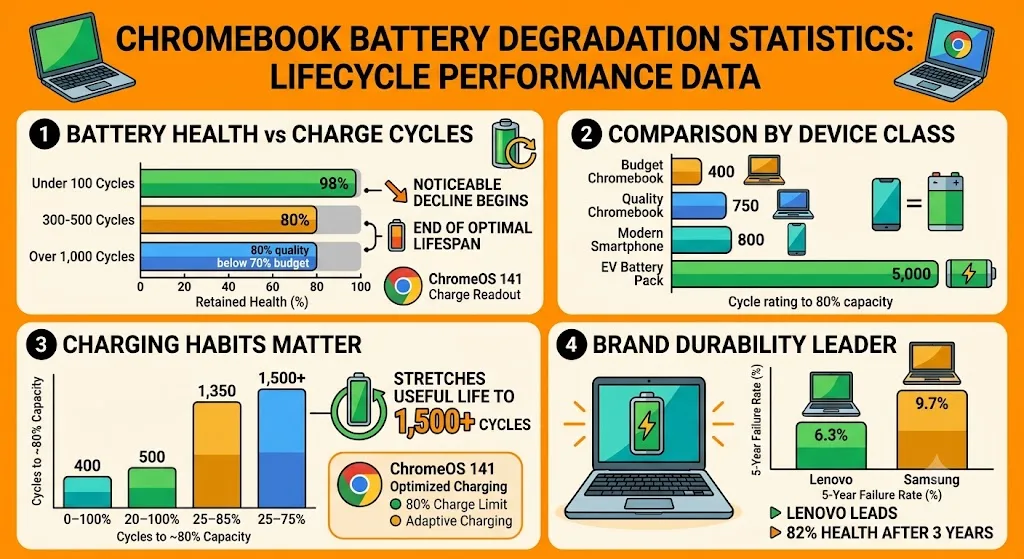
Quality Chromebook cells hold roughly 80% of original capacity at 1,000 charge cycles, while budget cells cross that line at 300 to 500 cycles. This brief covers Chromebook battery degradation by cycle count, performance against other lithium-ion classes, the impact of charging habits, and the ChromeOS features now built to slow wear.
Chromebook Battery Degradation Statistics 2026 – TL;DR
- Chromebook batteries retain 88 to 95% health across the first 100 to 300 charge cycles.
- Quality cells reach about 80% capacity near 1,000 cycles; budget cells hit that floor at 300 to 500 cycles.
- A 25 to 75% charge window stretches useful life to 1,500+ cycles, against 300 to 500 for full 0 to 100% cycling.
- ChromeOS 141 rolled out a user-facing 80% Charge Limit in October 2025.
- Lenovo leads brand durability at 82% battery health after three years and a 6.3% five-year failure rate.
Below 60% battery health, ChromeOS may throttle performance and replacement becomes the practical fix. The average Chromebook lifespan reached 7.6 years in 2026, with education and government deployments outlasting consumer models.
Chromebook Battery Degradation Statistics 2026 by Charge Cycle Count
A Chromebook battery stays above 80% health through its first 300 to 500 charge cycles. After that, capacity loss shows up in daily runtime. At 80% health, a device that once ran 10 hours delivers about 8.
| Charge cycles | Battery health retained | Practical status |
|---|---|---|
| Under 100 | 96–100% | As-new performance |
| 100–300 | 88–95% | Minor wear |
| 300–500 | ~80% | Noticeable decline begins |
| 500–1,000 | 70–80% | Replacement commonly considered |
| Over 1,000 | ~80% (quality) / below 70% (budget) | End of optimal lifespan |
Source: TechMedicVT, Chargie
Used-buyer guidance flags cycle counts above 200 to 250 as a warning sign of reduced remaining capacity. The exact figure is readable from ChromeOS’s built-in battery readout, which lists both health and cycle count.
Chromebook Battery Capacity After 1,000 Cycles vs Other Lithium-Ion Classes
Consumer products carry conservative cycle specs of 300 to 500. Modern smartphones now require 800 cycles minimum. EV battery packs target around 5,000 cycles.
| Device class | Cycle rating to 80% | Capacity at ~1,000 cycles |
|---|---|---|
| Budget Chromebook / consumer laptop cell | 300–500 | Well below 80% |
| Quality Chromebook lithium-ion cell | 500–1,000 | ~80% |
| Modern smartphone | 800+ | Near 80% at rating |
| EV battery pack | ~5,000 | Above 90% |
Source: Battery University, TechMedicVT
Chromebooks sit at the lower-cost end of the lithium-ion spectrum. The same cycle count that barely touches a phone or EV pack effectively retires a budget ChromeOS device.
How Charging Habits Change Chromebook Battery Degradation
Depth of discharge drives cycle life on a steep curve. Full 0 to 100% cycling lasts only 300 to 600 cycles. Holding discharge to about 50% lifts that to 1,200 to 1,500 cycles.
| Charge window | Depth of discharge | Cycles to ~80% capacity |
|---|---|---|
| 0–100% | 100% | 300–500 |
| 20–100% | 80% | ~500 |
| 25–85% | 60% | 1,200–1,500 |
| 25–75% | 50% | 1,500+ |
Source: BonnenBatteries, Battery University
One dataset puts a 20% depth-of-discharge cell at up to 2,000 cycles against 300 for a fully cycled one. Battery University modeling shows the gap even wider over the long run: cycling between 25% and 75% holds 74% capacity after 14,000 cycles, against 48% for full-range cycling. That mechanism is the reason behind every charge-limit feature ChromeOS now ships.
ChromeOS Battery Health Features Cutting Chromebook Degradation
ChromeOS 134 introduced the charge-limit policy in March 2025, letting admins and users cap maximum charge to reduce wear, with 100% kept as the default. ChromeOS 141 surfaced this to everyone in October 2025 through an Optimized Charging menu offering an 80% Charge Limit or Adaptive Charging.
| ChromeOS version | Released | Feature | Effect on degradation |
|---|---|---|---|
| ChromeOS 134 | March 2025 | Battery charge limit policy | Caps maximum charge; default stays 100% |
| ChromeOS 141 | October 2025 | User-facing Optimized Charging | Charge Limit (80%) plus Adaptive Charging |
| Adaptive Charging | Rolling | ML-timed full charge | Holds at 80% until unplug is likely |
Source: PCWorld, Chrome Unboxed, Chromium ChromeOS Documentation
Adaptive Charging delays going past 80% until a machine-learning model predicts the charger will be unplugged within about two hours. It can hold charge current to 0.1C to slow the final top-up. These features matter more now that 83% of active Chromebooks qualify for 10 years of updates in 2026, up from 68% in 2024, based on auto-update expiration data.
Chromebook Battery Health Retention by Brand and Segment
Lenovo leads on durability. The brand retains 82% battery health after three years of use alongside the lowest failure rate at 6.3% after five years. Samsung records the highest failure rate at 9.7%.
| Segment / Brand | Battery health after 3 years | Average lifespan | 5-year failure rate |
|---|---|---|---|
| Lenovo | 82% | 8.2 years | 6.3% |
| Samsung | — | — | 9.7% |
| Education devices | — | 8.1 years | — |
| Government devices | — | 8.3 years | — |
| Consumer devices | — | 6.9 years | — |
Source: AboutChromebooks
Battery degradation ranks among the most common Chromebook hardware failure points. When a device stops powering on entirely, the cause is often the charger or port rather than the cell, which is worth ruling out before a Chromebook not charging issue gets blamed on degradation.
Chromebook Battery Degradation Statistics 2026: Key Figures
The numbers converge on one picture. Chromebook batteries hold above 80% health for 300 to 500 cycles and reach 80% capacity near 1,000 cycles on quality cells. Full 0 to 100% charging lasts 300 to 500 cycles, while a 25 to 75% window pushes useful life several times further.
ChromeOS 141 now puts an 80% charge cap one toggle away for the 83% of devices riding the 10-year update policy. Lenovo’s 82% three-year health retention sets the current durability ceiling among major brands tracked in recent Chromebook reliability data.
FAQs
How many charge cycles does a Chromebook battery last?
Quality Chromebook cells last 500 to 1,000 cycles before capacity drops to about 80% of new. Budget cells reach that point at 300 to 500 cycles. ChromeOS shows the exact cycle count in its built-in battery readout.
At what battery health should I replace my Chromebook battery?
Replacement is commonly considered between 70 and 80% health. Below 60%, ChromeOS may throttle performance, which is the practical signal to swap the battery or the device.
Does the 80% charge limit in ChromeOS actually reduce battery wear?
Yes. Cycling between 25 and 75% holds 74% capacity after 14,000 cycles versus 48% for full-range cycling, based on Battery University modeling. The 80% cap captures most of that benefit.
Which Chromebook brand has the best battery durability?
Lenovo. The brand retains 82% battery health after three years and posts a 6.3% five-year failure rate, the lowest among major Chromebook brands tracked in 2026 data.
How long do Chromebooks last on average in 2026?
The average Chromebook lifespan reached 7.6 years in 2026. Government devices average 8.3 years, education devices 8.1 years, and consumer devices 6.9 years.
Sources
https://batteryuniversity.com/article/bu-808-how-to-prolong-lithium-based-batteries