
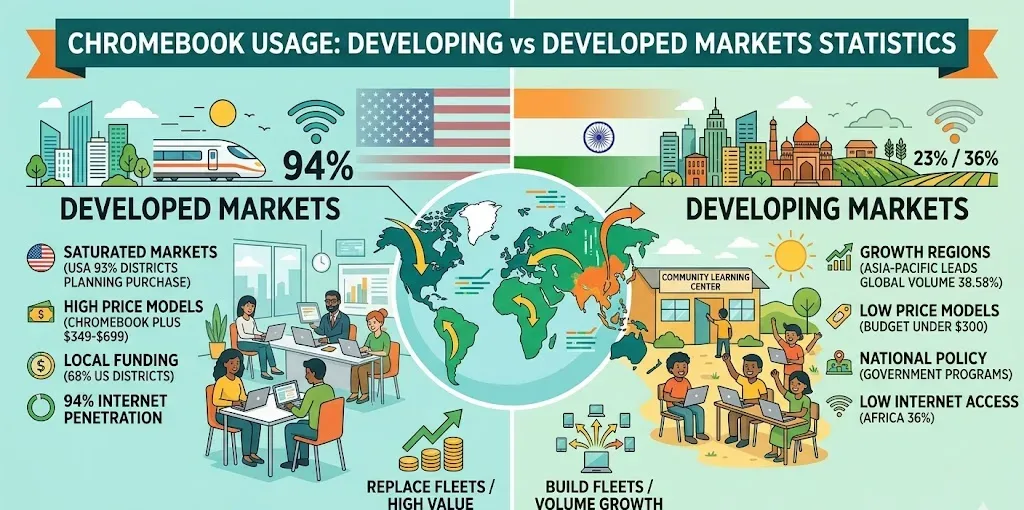
Chromebook adoption splits along income lines. In 2025, 94% of people in high-income countries used the internet against just 23% in low-income countries, a 71-point gap that frames every figure below (Source: ITU). This post compares Chromebook usage in developing vs developed markets with verified 2024 to 2026 data on regional share, government programs, US saturation, and price.
Chromebook Usage in Developing vs Developed Markets – TL;DR
- The global Chromebook market reached $14.7 billion in 2025 and is projected to hit $42.85 billion by 2034, a 12.62% CAGR (Source: Custom Market Insights).
- Asia-Pacific leads global volume at 38.58%, ahead of Europe at 25.13% and North America at 22.73% (Source: MMR Statistics).
- Education drives 60.1% of all Chromebook purchases worldwide (Source: About Chromebooks).
- ChromeOS holds 8.44% of US desktops against 1.86% globally (Source: About Chromebooks).
- Standard Chromebooks run $200 to $400; Chromebook Plus models run $349 to $699 (Source: About Chromebooks).
Developed markets buy on refresh cycles and saturation. Developing markets buy on first-time access and government rollout. The income divide shows up first in connectivity, then in funding model and price point. Around 22.11 million units shipped in 2025, and the value curve below tracks the projected path to 2034.
Chromebook Market Share by Region: Developed vs Developing
Asia-Pacific led global Chromebook volume in 2025 at 38.58%, ahead of Europe at 25.13% and North America at 22.73% (Source: MMR Statistics). The region runs on large education programs and low prices, with India’s National Education Policy, Indonesia’s public schools, and Japan’s GIGA School Project behind the lead.
Developing-heavy regions are not small. South America at 8.39% and the Middle East and Africa at 5.17% hold 13.56% combined, while developed Europe and North America hold 47.86% together (Source: MMR Statistics). A single developing-heavy region now outsells either Western bloc alone, a point that also surfaces in the latest Chromebook user-base figures.
| Region | Share of Global Volume (2025) | Market Maturity |
|---|---|---|
| Asia-Pacific | 38.58% | Mixed |
| Europe | 25.13% | Developed |
| North America | 22.73% | Developed |
| South America | 8.39% | Developing |
| Middle East & Africa | 5.17% | Developing |
Source: MMR Statistics
What Drives Chromebook Adoption in Developing Markets?
A Chromebook needs a connection, so internet access sets the ceiling. Low-income countries sat at 23% online in 2025 against 94% in high-income countries (Source: ITU).
Africa, where Chromebook penetration is earliest, reached 36% (Source: ITU). Least developed countries hit 34% and landlocked developing countries 38%, but both grew faster than the global average, at 7.4% and 5.5% in 2025 (Source: ITU).
Demand tracks the middle-income tier more than the poorest economies, where connectivity still blocks mass entry. That infrastructure question is central to whether a Chromebook is worth buying in these regions.
| Market Group | Internet Penetration (2025) |
|---|---|
| High-income countries | 94% |
| Low-income countries | 23% |
| Least Developed Countries | 34% |
| Landlocked Developing Countries | 38% |
| Africa (region) | 36% |
Source: ITU
Government Programs Driving Chromebook Usage in Developing Markets
Japan’s GIGA program distributed about 7.4 million devices in phase one. iPad took 2.1 million units, about 28%, and Windows plus ChromeOS split the remaining 5.3 million (Source: Starry Hope). About half of Japan’s local boards of education chose Google for Education (Source: News On Japan).
Developed-market buying is concentrated and bulk. New York City announced 350,000 free Chromebooks for K-12 across more than 1,700 schools for 2025 to 2026, a $327 million order (Source: NYC Mayor’s Office).
Developing markets buy through broad national policy instead. India’s NEP and Indonesia’s public schools push the APAC growth segment to a 4.7% CAGR (Source: About Chromebooks). Developed markets replace fleets; developing markets build them, the same split that drives how Chromebooks beat the iPad in K-12.
| Program / Market | Scale | Type |
|---|---|---|
| Japan GIGA School (Phase 1) | ~7.4M devices | Developed |
| Japan ChromeOS + Windows split | 5.3M of 7.4M units | Developed |
| New York City Public Schools (2025-26) | 350,000 Chromebooks | Developed |
| India / Indonesia (NEP, public education) | 4.7% CAGR segment | Developing |
Source: Starry Hope, NYC Mayor’s Office, About Chromebooks
US Chromebook Saturation vs Developing-Market Headroom
The clearest sign of a mature market is funding. 68% of US districts now pay for Chromebooks from local or state budgets rather than pandemic-era federal money like ESSER (Source: About Chromebooks). That is a planned refresh, not crisis buying, a pattern detailed in the shift to local school funding.
District purchase plans reached 93% in 2026, up from 84% in 2023, near a ceiling (Source: About Chromebooks).
ChromeOS desktop share shows the headroom. The US sits at 8.44% against 1.86% worldwide, a gap covered in the ChromeOS desktop share breakdown. Developing markets sit far below the US line, which is where the runway is (Source: About Chromebooks).
| Metric | Value | Market |
|---|---|---|
| US districts planning purchases (2026) | 93% (from 84% in 2023) | Developed |
| US districts funding via local/state budgets | 68% | Developed |
| ChromeOS desktop share, United States | 8.44% | Developed |
| ChromeOS desktop share, global | 1.86% | Mixed |
| Global education device market held by Chromebooks | 60.1% | Mixed |
Source: About Chromebooks
Chromebook Pricing Across Developed and Developing Markets
Price opens developing markets. Standard Chromebooks run $200 to $400, with budget models under $300 (Source: About Chromebooks).
Lower cost is a stated adoption driver in poorer nations, where price is the main barrier (Source: Business Research Insights).
Developed markets trade up. The $349 to $699 Chromebook Plus tier, with 8 GB RAM minimum, holds 5 to 10 extra points of resale value at each age stage (Source: About Chromebooks). The spec gap is widening, and 2026 memory costs are pushing both tiers higher, as the full price-tier and spec comparison lays out.
| Price Tier | Range (2026) | Typical Spec | Primary Market |
|---|---|---|---|
| Budget standard | Under $300 | 4 GB RAM, 64-128 GB eMMC | Developing |
| Standard | $200-$400 | 4 GB RAM, 64-128 GB eMMC | Both |
| Chromebook Plus | $349-$699 | 8 GB RAM, 128 GB SSD, 1080p IPS | Developed |
Source: About Chromebooks
What the Numbers Say
Three things separate the two markets. Connectivity sets the floor: a 71-point internet gap keeps the poorest markets out of scale adoption (Source: ITU).
Funding marks maturity: 68% local-budget funding in the US signals a refresh market, while developing economies still build fleets through national policy (Source: About Chromebooks).
Price defines the product: sub-$300 units in growth markets against $349 to $699 Plus models in saturated ones (Source: About Chromebooks). Asia-Pacific’s 38.58% share shows developing-heavy regions now rival the developed West on units, even as the income divide locks the deepest growth behind infrastructure (Source: MMR Statistics).
FAQs
Which region uses the most Chromebooks?
Asia-Pacific, at 38.58% of global volume in 2025, ahead of Europe at 25.13% and North America at 22.73%. India, Indonesia, and Japan’s GIGA School Project drive the lead (Source: MMR Statistics).
How big is the global Chromebook market?
It reached $14.7 billion in 2025 and is projected to hit $42.85 billion by 2034 at a 12.62% CAGR. About 22.11 million units shipped in 2025 (Source: Custom Market Insights, About Chromebooks).
Why do developing markets adopt Chromebooks more slowly?
Internet access. Only 23% of people in low-income countries were online in 2025 against 94% in high-income countries. A Chromebook’s cloud-based model cannot work at scale without connectivity (Source: ITU).
How much does a Chromebook cost?
Standard models run $200 to $400, with budget units under $300. Chromebook Plus devices cost $349 to $699 and require at least 8 GB RAM (Source: About Chromebooks).
How saturated is the US Chromebook market?
93% of US school districts plan purchases in 2026, up from 84% in 2023. 68% now fund through local or state budgets, a sign of a mature refresh market (Source: About Chromebooks).
Sources
https://www.itu.int/itu-d/reports/statistics/
https://www.custommarketinsights.com/