
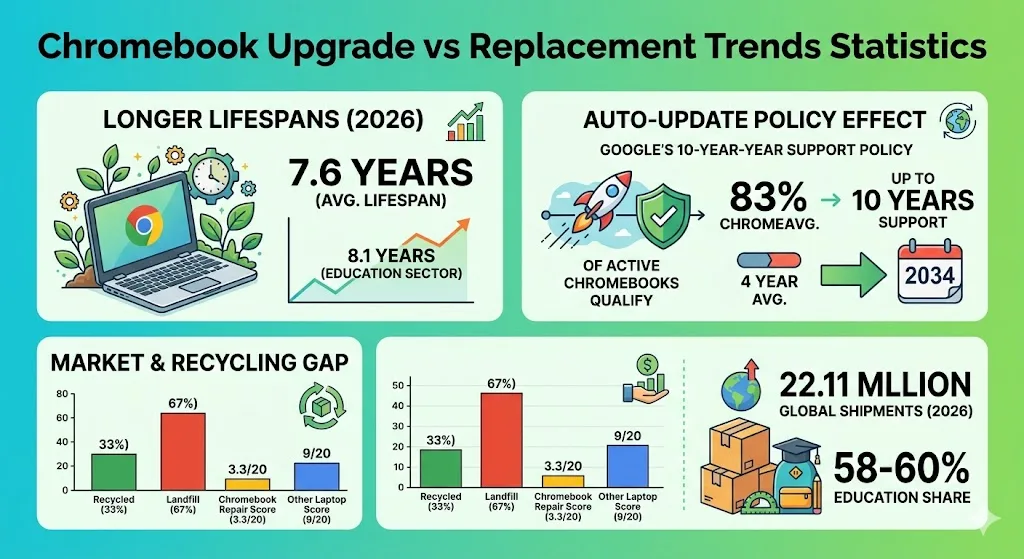
School Chromebooks averaged roughly four years of use before 2024 — not because the hardware wore out, but because software support expired. Google’s 10-year auto-update policy, fully in effect since 2024, has changed that calculus. This article covers verified 2026 statistics on Chromebook lifespans by segment, replacement triggers, e-waste costs, and market volumes.
Chromebook Upgrade vs. Replacement: Key Statistics
- The average Chromebook lifespan reached 7.6 years in 2026, up from roughly 4 years under the previous support policy.
- 83% of active Chromebooks now qualify for 10-year auto-update support, up from 68% in 2024.
- Education-sector Chromebooks average 8.1 years of use in 2026, nearly double the pre-2024 school average.
- Only about one-third of expired Chromebooks are properly recycled; the rest end up as landfill e-waste.
- 93% of US school districts planned Chromebook purchases in 2025, compared to 84% in 2023.
Chromebook Lifespan Statistics by Segment (2026)
The cross-segment average lifespan of 7.6 years in 2026 is up 5.6% from 2024, driven by the 10-year AUE policy taking hold across newer device cohorts. Consumer-grade devices average 6.9 years, held down by thinner hardware in the sub-$300 range. Education fleets average 8.1 years, reflecting structured management cycles and lower failure rates.
The most telling comparison is between today’s 8.1-year education average and the pre-2024 figure of roughly four years. Before Google’s policy change, school Chromebooks were replaced when AUE dates arrived — regardless of physical condition. Lenovo devices post the lowest hardware failure rate in the segment at 6.3% after five years, contributing to that brand’s 8.2-year average lifespan.
| Segment | Average Lifespan (2026) | Key Driver |
|---|---|---|
| All Chromebooks (cross-segment) | 7.6 years | 10-year AUE policy from 2024 |
| Consumer-grade | 6.9 years | Hardware wear on budget models |
| Education sector | 8.1 years | Managed fleets, structured refresh cycles |
| Government sector | 8.3 years | Stricter procurement, longer retention |
| Lenovo Chromebooks | 8.2 years | Lowest hardware failure rate in segment |
| Average school lifespan (pre-2024) | ~4 years | AUE constraints, not hardware failure |
Source: About Chromebooks, U.S. PIRG Education Fund
How Has Google’s AUE Policy Changed Chromebook Replacement Cycles?
Before 2024, Chromebooks received between three and eight years of support from the platform release date, which left most school-purchased devices with roughly four years of remaining support at the point of purchase. From 2024 onward, all devices released from 2021 qualify for a full 10-year window. Pre-2021 devices can be enrolled through the admin console.
The share of active Chromebooks covered by the 10-year policy rose from 68% in 2024 to 83% in 2026. As pre-2021 hardware ages out of service, that figure will continue rising. A 2024 Chromebook, for example, carries an auto-update expiry date of 2034.
One practical detail for procurement teams: AUE is counted from the platform release date, not the purchase date. A device purchased in late 2024 on a platform certified in early 2024 carries slightly under 10 years of remaining support from the moment of purchase. Verifying AUE through Google’s Admin Console before bulk orders is standard practice for districts managing large fleets.
| Metric | Before 2024 | From 2024 Onward |
|---|---|---|
| AUE window (range) | 3–8 years from platform release | 10 years from platform release |
| Avg. remaining support at purchase | ~4 years | Up to 10 years (2021+ devices) |
| Primary replacement trigger | AUE date reached | Physical wear |
| Active Chromebooks on 10-year policy | 68% (2024) | 83% (2026) |
| Example: 2024 Chromebook expiry | N/A | 2034 |
| Example: 2021 Chromebook expiry | N/A | 2031 |
Source: Google Auto Update Policy, AGP360, About Chromebooks, Starry Hope
Chromebook E-Waste and Cost Statistics
The U.S. PIRG Education Fund’s “Chromebook Churn” report quantified the cost of the old short-cycle replacement model. With 48.1 million K-12 students in the US receiving Chromebooks, the volume of devices cycling out every four years was substantial. Only about one-third of those devices ended up properly recycled; the remaining two-thirds went to landfill.
If school Chromebook lifespans had been doubled under the old policy, the PIRG report estimated taxpayers could have saved $1.8 billion. On emissions, doubling the lifespan of 2020-era Chromebooks would have cut CO2 equivalent to removing roughly 900,000 cars from the road for a year.
Repairability remains a structural gap. Chromebooks score an average of 3.3 out of 20 on France’s device repairability index, compared to 9 out of 20 for comparable laptops. Manufacturers have not historically produced or distributed spare parts for Chromebooks, leaving schools to either scavenge parts from broken units or absorb full replacement costs. The 10-year software policy does not address this hardware-level problem.
| Metric | Figure |
|---|---|
| US K-12 students with Chromebooks | 48.1 million |
| Chromebook e-waste properly recycled | ~33% |
| Taxpayer savings if lifespans doubled | $1.8 billion |
| CO2 equivalent (doubled 2020 lifespans) | 900,000 cars off road for 1 year |
| Chromebook repairability score (French index) | 3.3 / 20 |
| Non-Chromebook laptop score (same index) | 9 / 20 |
| Q4 2020 Chromebook sales vs Q4 2019 | +287% |
Source: U.S. PIRG Education Fund, iFixit, Starry Hope, PCWorld
Chromebook Market and Shipment Data (2024–2026)
Global Chromebook shipments reached 22.11 million units in 2026. The education segment accounts for 58–60% of that total, making K-12 upgrade and replacement decisions the primary demand driver for the entire market. North America held 53% of global shipments in 2024, reflecting the scale of US school deployments.
Lenovo shipped 3.5 million Chromebook units in H1 2025 alone, a 27% year-over-year increase. HP led in Q2 2024 with approximately 1.67 million units shipped that quarter. At the market level, the Chromebook segment was valued at $14.70 billion in 2025.
Google’s own cost data shows Chromebooks carry a 55% lower device cost and 57% lower operational cost compared to Windows devices. An Intel field study found 90% fewer hardware-related service calls for ChromeOS versus legacy Windows configurations — a factor that directly supports the longer managed-fleet lifespans recorded in the education and government sectors.
| Metric | Figure | Source |
|---|---|---|
| Global Chromebook shipments (2026) | 22.11 million units | About Chromebooks / Mordor Intelligence |
| Chromebook market value (2025) | $14.70 billion | Market Research Future |
| Education segment share of market | 58.3–60.1% | About Chromebooks, Amra and Elma |
| US districts planning purchases (2025) | 93% | Mordor Intelligence |
| US districts planning purchases (2023) | 84% | Mordor Intelligence |
| North America share of global shipments (2024) | 53% | Business Research Insights |
| Lenovo H1 2025 shipments | 3.5 million (+27% YoY) | Market Research Future |
| Lower device cost vs Windows (Google) | 55% | Google Blog |
| Lower operational cost vs Windows (Google) | 57% | Google Blog |
| Fewer hardware service calls vs Windows (Intel) | 90% | Mordor Intelligence |
Source: About Chromebooks, Mordor Intelligence, Market Research Future, Business Research Insights, Google Blog
FAQs
What is the average lifespan of a Chromebook in 2026?
The cross-segment average lifespan is 7.6 years in 2026. Education-sector Chromebooks average 8.1 years, while consumer-grade devices average 6.9 years, according to About Chromebooks.
Why were school Chromebooks replaced so quickly before 2024?
Before the 10-year AUE policy, most school devices had roughly four years of software support remaining at purchase. Expired AUE dates — not hardware failure — triggered replacement, since unsupported devices couldn’t access security updates or online testing platforms.
What percentage of Chromebooks qualify for the 10-year update policy in 2026?
83% of active Chromebooks were on the 10-year auto-update policy as of 2026, up from 68% in 2024. All devices from 2021 onward qualify automatically; pre-2021 devices require admin console enrollment.
How much e-waste do retired Chromebooks generate?
Only about one-third of expired Chromebooks are properly recycled. The rest go to landfill. Chromebooks also score just 3.3 out of 20 on France’s repairability index, versus 9 out of 20 for comparable laptops, per the U.S. PIRG Education Fund.
How big is the Chromebook market in 2025–2026?
The Chromebook market was valued at $14.70 billion in 2025. Global shipments reached 22.11 million units in 2026, with the education segment accounting for roughly 58–60% of total sales.