
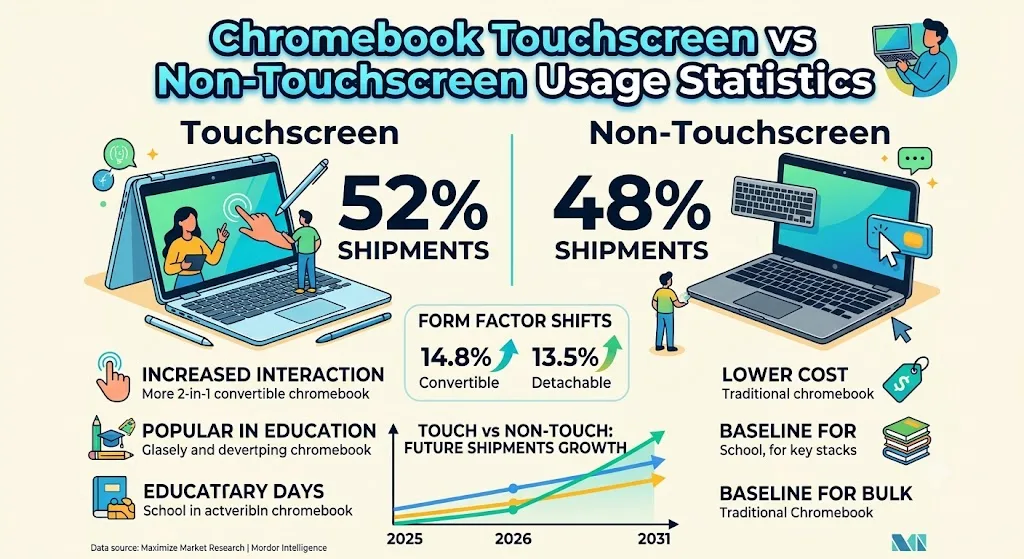
Touchscreen Chromebooks held 52% of total shipments in 2025, while non-touchscreen clamshells held the other 48%. This post breaks down the touch versus non-touch split by form factor, price premium, battery trade-off, sector demand, region, and shipment forecast through 2031. Every figure traces to a verified market report.
Chromebook Touchscreen vs Non-Touchscreen Usage Statistics 2026 – TL;DR
Five numbers sum up where the touch versus non-touch split stands in 2026.
- Touchscreen Chromebooks hold a 52% share of total shipments; non-touchscreen models hold 48%.
- Convertible 2-in-1 and detachable tablet form factors, both touch-enabled by design, together make up 28.3% of shipments.
- Touchscreen panels add a 20% to 30% price premium over comparable non-touch units.
- A touchscreen layer cuts battery runtime by 5% to 7% versus an identical non-touch display.
- Only 18% of enterprises have standardized on touchscreen devices, while clamshells still carry 62.85% of education shipments.
Touchscreen vs Non-Touchscreen Chromebook Market Split in 2026
The touchscreen segment passed the halfway mark in 2025 and is the faster-growing of the two. Demand tracks the rise of convertible and 2-in-1 designs that work as both a tablet and a laptop.
| Screen Type | 2025 Share | Trajectory |
|---|---|---|
| Touchscreen | 52% | Growing faster |
| Non-Touchscreen | 48% | Steady decline |
Source: Maximize Market Research
The 52% figure does not mean half of buyers want tablet-style devices. Most touch shipments are still clamshell laptops that happen to include a touch panel. A non-touch unit remains the cheaper default, which is why nearly half the market still ships without touch. For a wider hardware view, see the Chromebook hardware statistics breakdown.
Chromebook Form Factor Breakdown: Touchscreen vs Non-Touchscreen Devices
Form factor is the cleanest way to read the touch split. Convertibles and detachable tablets are touch-enabled by definition, while clamshells come in both touch and non-touch versions.
| Form Factor | Market Share | Touch Status | Growth (CAGR) |
|---|---|---|---|
| Clamshell Laptop | 62.85% | Mixed (touch + non) | 3.4% |
| Convertible 2-in-1 | 14.8% | Always touch | 6.4% |
| Detachable Tablet | 13.5% | Always touch | 9.05% |
| Other / Hybrid | 8.85% | Mostly non-touch | 2.1% |
Source: Mordor Intelligence
Detachable tablets are the fastest-growing format at a 9.05% CAGR, driven by early-grade classrooms running handwriting and touch-based curricula. Clamshells stay dominant because typing-heavy schoolwork and standardized testing need a fixed keyboard, a pattern detailed in the Chromebooks in schools statistics.
Touchscreen vs Non-Touchscreen Chromebook Price Premium Statistics
Cost is the main reason non-touch units keep half the market. Adding a digitizer and touch glass raises the bill of materials, and that cost reaches the buyer.
| Specification | Non-Touchscreen | Touchscreen |
|---|---|---|
| Relative unit price | Baseline | +20% to +30% |
| Typical entry price | $200 – $400 | Higher within tier |
| Bulk education fit | Stronger | Weaker |
Source: Intel Market Research
The 20% to 30% premium has slowed touch adoption in price-sensitive education tenders, where a district buying thousands of units feels the gap directly. A standard non-touch Chromebook still lands in the $200 to $400 range, which keeps it the default for one-to-one fleet rollouts. The pricing curve is mapped further in the Chromebook price vs performance data.
Chromebook Touchscreen Battery and Performance Trade-Off Data
Touch panels draw extra power, so a touchscreen unit runs shorter than an identical non-touch model on the same battery. The gap is small but consistent across testing.
| Metric | Non-Touchscreen | Touchscreen |
|---|---|---|
| Battery runtime | Baseline | 5% to 7% lower |
| Display power draw | Lower | Higher |
| Weight and thickness | Lower | Slightly higher |
Source: Intel Market Research
A 5% to 7% runtime cut sounds minor, but on a school device rated for a full day of use, it can be the difference between lasting through afternoon classes and needing a midday charge. User-reported impressions of these trade-offs appear in the Chromebook user satisfaction by use case data.
Touchscreen vs Non-Touchscreen Chromebook Adoption by Sector
Sector demand splits sharply. Enterprises lean non-touch, while education buys a mix weighted toward clamshells but increasingly open to convertibles and detachables in lower grades.
| Sector | Dominant Choice | Supporting Stat |
|---|---|---|
| Enterprise | Non-touchscreen | 18% standardized on touch |
| K-12 Education | Clamshell (mixed touch) | 62.85% of edu shipments clamshell |
| Early-grade classrooms | Touch detachables | Tablet format at 9.05% CAGR |
Source: Intel Market Research, Mordor Intelligence
Just 18% of enterprises have standardized touchscreen hardware for their workforce, with most IT teams citing input habits and support overhead. Education is more divided, since the clamshell still anchors typing and testing while touch slates gain ground in handwriting-focused early grades. The contrast between slate and clamshell demand is covered further in the Chromebook vs tablet usage in education statistics.
Chromebook Touchscreen vs Non-Touchscreen Usage Statistics 2026 by Region
North America buys the most Chromebooks overall, and its K-12 weighting keeps non-touch clamshells in heavy rotation. Asia-Pacific is the fastest-growing region, and its convertible demand lifts the touch share there.
| Region | Share of Market | Growth (CAGR) | Touch Lean |
|---|---|---|---|
| North America | 51.95% | 3.51% | Clamshell-weighted |
| Asia-Pacific | Fastest-growing | 4.55% | Convertible-weighted |
| Europe | Steady | ~3.2% | Mixed |
Source: Mordor Intelligence
North America held 51.95% of the market in 2025, and its purchasing is dominated by US school districts that favor low-cost clamshells. Asia-Pacific runs at the fastest pace, around a 4.55% CAGR, with markets like Japan and South Korea showing stronger appetite for convertible designs that push the regional touch share above the global average. Enterprise demand patterns sit in the Chromebook remote work adoption data.
Touchscreen vs Non-Touchscreen Chromebook Shipment Forecast
Total Chromebook volume is climbing on planned refresh cycles rather than pandemic-era emergency buying. Applying the 52% touchscreen share to verified unit totals shows where each segment stands.
| Year | Total Units | Touchscreen (52%) | Non-Touchscreen (48%) |
|---|---|---|---|
| 2025 | 22.11M | 11.50M | 10.61M |
| 2026 | 22.94M | 11.93M | 11.01M |
| 2031 (forecast) | 27.56M | Rising faster | Slower growth |
Source: Mordor Intelligence
Mordor Intelligence values 2025 at 22.11 million units, rising to 22.94 million in 2026 and 27.56 million by 2031 at a 3.74% CAGR. Touch is the faster-growing of the two through the forecast window, so its share is set to widen past 52% while non-touch volume grows more slowly. Display sizing trends across both segments appear in the most popular Chromebook screen sizes data, and the wider market view sits in the Chromebook user base statistics.
FAQs
What percentage of Chromebooks are touchscreen in 2026?
Touchscreen models account for 52% of Chromebook shipments, and non-touchscreen models account for 48%, based on 2025 screen-type market data from Maximize Market Research.
Why do half of Chromebooks still ship without a touchscreen?
Cost is the main reason. A touchscreen panel adds a 20% to 30% price premium, which keeps non-touch clamshells the default for budget-driven education fleets buying thousands of units at a time.
Does a touchscreen reduce Chromebook battery life?
Yes. A touch panel draws extra power and cuts battery runtime by 5% to 7% compared with an identical non-touch display. On a full-day school device, that can mean a midday charge.
Are convertible and detachable Chromebooks always touchscreen?
Yes. Convertible 2-in-1 and detachable tablet form factors are touch-enabled by design and together make up 28.3% of shipments. Clamshells come in both touch and non-touch versions.
Which sector prefers non-touchscreen Chromebooks?
Enterprise buyers lean non-touch, with only 18% having standardized on touchscreen hardware. Education buys a mix, with clamshells still carrying 62.85% of education shipments.
https://www.maximizemarketresearch.com/market-report/chromebook-market/146506/
https://www.marketresearchfuture.com/reports/chromebook-market-31935
https://www.cognitivemarketresearch.com/chromebook-market-report